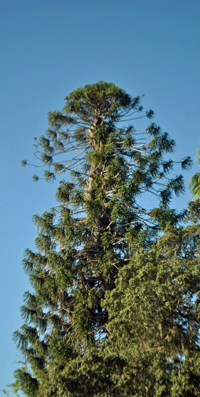
On a crispy summer day with a cup of coffee for myself and the landscapers about to take down a sick tree on my property, I stood out in front of my home talking with them about the most bizarre tree in our neighborhood, a Monkey Puzzle. I had never seen a tree this tall in Florida. We spent some time estimating if it might someday hit my century-old home if it ever fell.
“See,” I told them, “There’s a spell on that tree.” I began to wind my way to telling them about it, when a strong breeze flew by. I think if the wind blew right, it would just miss my house. “But what are the chances?” we carried on. “But what if lighting hit the tree? A hurricane? A tornado?” We laughed turning away from Monkey Puzzle to look at the tree that was about to meet its demise, when Monkey Puzzle made three thunderous thumping sounds behind us.
“See!” I told them, “There is a spell on that tree.” It was a quieting moment. Should I not have said that out loud?
While there are several variations of the spell, the one that haunts this particular tree is about the devil incarnate, a naked entity named Jack Skellington, who sits atop the fiery nest at the apex of this pyramidal conifer. Jack, when he’s around, is cradled in Monkey Puzzle’s barb-wired branches. Within this perch, the tips of his skeletal fingers barely visible with orange discharges firing into a perfectly blue sky.
Jack doesn’t sit there all the time though, but for bits and whiles at this time of the year, long enough to spook those who can see — or in our case, hear — him. Everyone around Monkey Puzzle must be quiet while Jack’s there lest they attract his attention and grow a monkey’s tail for three years, during which time all manner of bad luck would befall the ruckster.
About Those Thumps

Monstrously big, pineapple-shaped, pine-like cones. About 15 pounds a piece, hitting the ground (and, I’m told, one time, a girl scout). It has a milky center. The only milk one can trust in Florida doesn’t come from flora.
No doubt it was Jack in that tree unlatching these enormous pine cones, trying to shut us down, telling us not to speak of its ancientness, its expansive survival, and its substantial lore. It was as if the tree itself was insisting on quiet, warning us, “I control.”
I made a deal with that tree shortly after this incident to tell its story but only in the hushed process of writing. Keeping its history so Jack wouldn’t do to me what he did to the scout.
Long before slash pine and the Pinus genus in general covered thousands of acres in central Florida, and provided our area with its initial turpentine industry, Monkey Puzzle trees, our “living fossil,” dotted the landscape. Their knife-like, triangular leaves tightly knit around its trunk and branches evolved not to discourage monkeys, but rather to deter “the grazing dinosaurs of the Mesozoic era of 250 million years ago.”
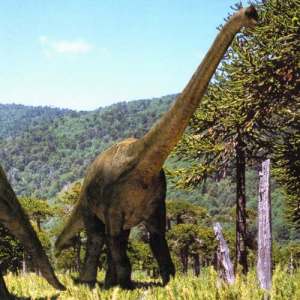
On a side note: In the 20th century, those knives were useful for keeping people away too. Monkey Puzzles can survive anything, especially the ravages of the turpentine industry that decimated an ecosystem in the central Florida area apparently. Through everything, Monkey Puzzles survived people in part because no one had the tools to cut a tree like this. Today we do. It’s called the chainsaw.
The rise of broad-leaf trees during the Cretaceous Period is the primary reason Monkey Puzzle trees are not too widespread. It also makes a terrible landscape tree, unless you have dozens of acres of property and need a naturally deadly fence.
This fire-resistant tree, however, the one across the street from me, is not on acres of land. It’s wedged in the smallest space possible, about 20 square feet between the 1925 “Girl Scout” house [i] and a pretty new home.
Monkey Puzzle, a native of Chile, can live to be a thousand years old. This one, standing at about 110 feet, could easily be a hundred, two, maybe three hundred years old. Without a shadow of a doubt, though, it was growing long before the Girl Scout house was built.

A prehistoric tree, an endangered tree. Monkey Puzzle tends to become invisible in a landscape, which is surely why Jack likes hanging out there. Arborists say that the tree is so open in habit you could almost look at it and not see it. Not even lightning bothers to find this tree.
If you look up close, sometimes you can see the biggest birds around, flying aloft Monkey Puzzle, then stopping for a rest: red-tailed hawks, vultures, and osprey. From the ground they must have looked like dancing devils to our ancestors; they must’ve looked like Jack in the Monkey Puzzle.
Endnotes
[i] 1 W Lemon Street, the Girl Scout house, formerly known as the Zentmeyer home; now known as the Summerlin house.
- Said Monkey Puzzle was cut down in 2017.
- Originally published: August 19, 2017.
Discover more from Darhlene.com
Subscribe to get the latest posts sent to your email.
